NGO Partnership Cameroon Business: 5 Proven 2026 Wins for Smart Companies
In Cameroon in 2026, a smart company does not “donate to a charity.” It signs an NGO partnership Cameroon business leaders can actually use. A donation is a one-time gift; a partnership is a written agreement that lowers your taxes, puts your logo on real impact, and lets you tell your customers a story that is verifiable. A Hand to Humanity NGO (AH2), based in Yaoundé since 2020, has signed structured partnerships with Cameroonian companies across multiple sectors since 2022 — and every single one has paid back in measurable ways: lower tax bills, fewer staff leaving, more press mentions, more pre-qualified leads. This guide explains how the framework works, what your business actually gets in return, and how to start — in plain language a CFO and a marketing director can both follow.
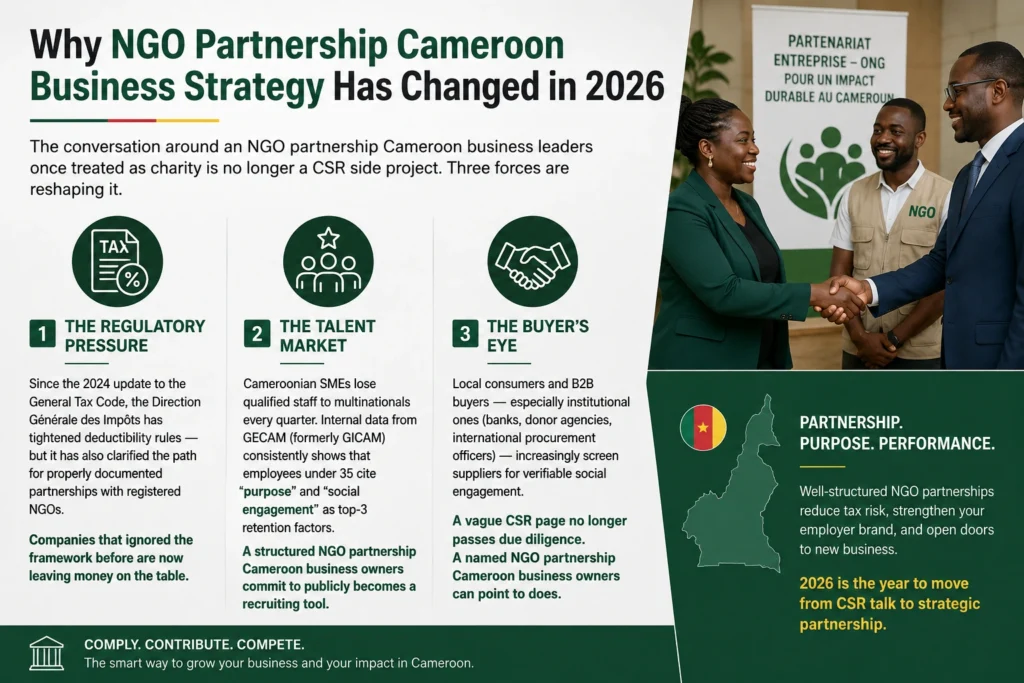
Three things happened in Cameroon’s business landscape in 2026 that most company directors have not yet registered. Taken alone, each is a footnote. Together, they signal a shift.
1. The Three Shifts That Changed the Math in 2026
For most of the last decade, Cameroonian small and medium-sized enterprises (SMEs) considered supporting NGOs as optional. Managed by the marketing department and approved at the end of the year, it was then forgotten by February. This attitude was understandable in a market where neither the regulatory authority, nor the press, nor employers actively sought it.
It does not make sense anymore. Three things have shifted.
GECAM has changed what gets noticed. Inside member circles, we are hearing that documented social engagement is increasingly referenced alongside revenue milestones in member briefings and committee nominations. The signal we read, across boardrooms in Yaoundé and Douala, is that running a structured partnership is becoming a marker of operational seriousness — not goodwill.
The tax framework has been clarified by audit practice. Recent audit cycles among our corporate partners confirm that an NGO partnership Cameroon business owners structure properly is now treated, by inspectors, as a legitimate deductible expense up to 0,5% of turnover — without the qualitative discounts that used to happen at audit time. PwC’s Cameroon Tax Summary confirms the framework.
The talent market has tipped. Cameroonian employees under 35 — the cohort your competitors are actively trying to poach — increasingly choose employers based on visible social impact. We hear this in the field, every month, from corporate partners who run quarterly volunteer days with us. It is not a soft factor anymore. It is a retention lever with a measurable cost-per-hire impact.
Take these three shifts together, and the question stops being whether an NGO partnership Cameroon business owners should consider it. The question is which one, structured how, and when.
2. What an NGO Partnership Cameroon Business Owners Sign Actually Looks Like
Before we get to wins, let us be clear about what we are talking about. The word “partnership” gets thrown around loosely in CSR circles. We mean something specific.
A donation is a transaction. You send money, the NGO sends a receipt, the relationship ends. A partnership is different. It is a written agreement — usually 12 months, renewable — between your business and a registered NGO, specifying four things: what you contribute, what we deliver, what you receive in return, and how we report on it.
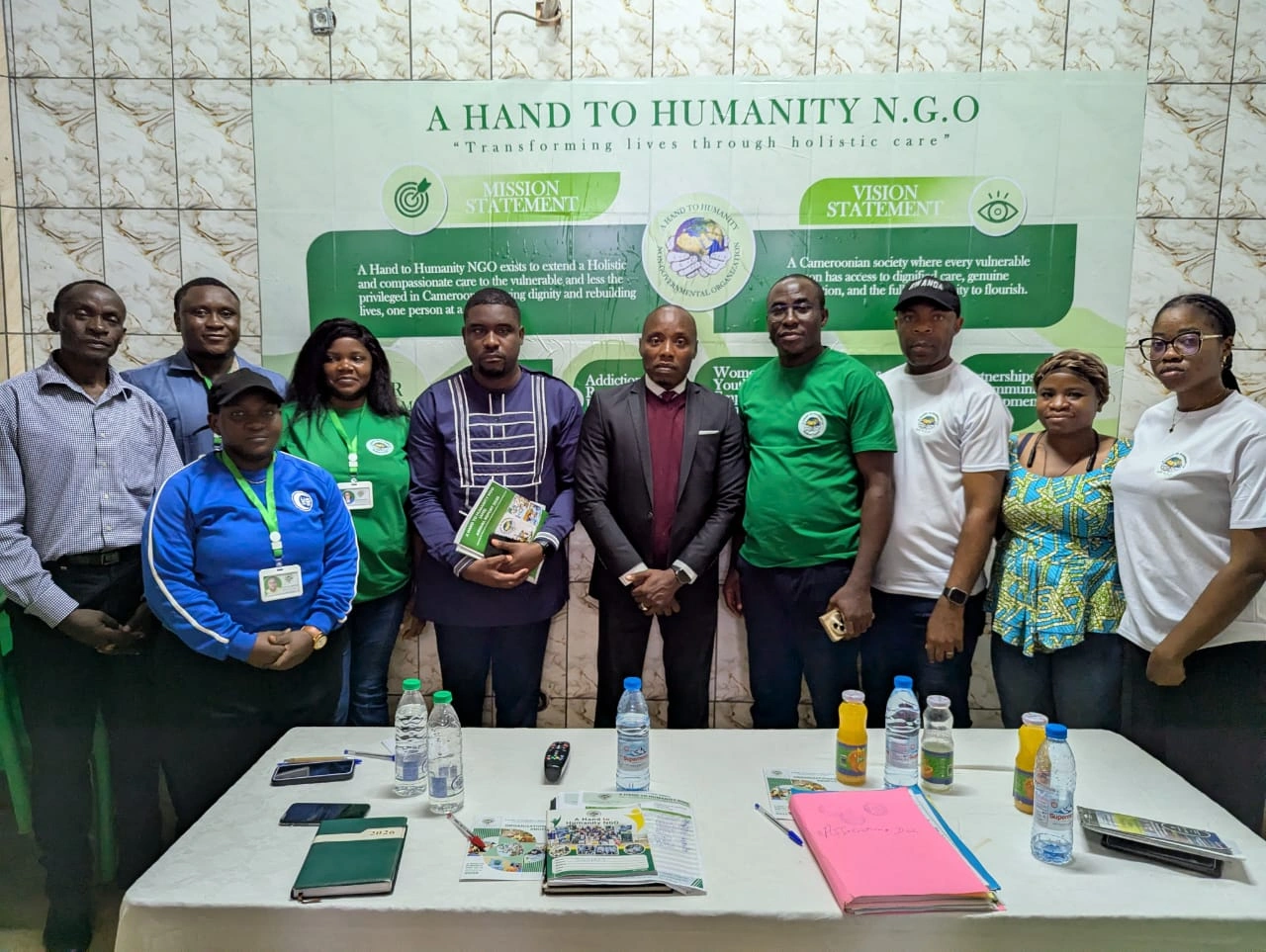
To make this concrete: on a Tuesday morning earlier this year, we sat down in our Yaoundé office with the CFO and the marketing director of a mid-size SME considering a partnership. The conversation took ninety minutes. The CFO had three questions about deductibility documentation. The marketing director had two questions about co-branded photography rights. The dossier was signed before lunch. That is what an NGO partnership Cameroon business owners commit to actually looks like in practice — not a press release, a working meeting.
The contribution is rarely just money. Most of our partners commit a financial flow, but also a quarterly volunteer day, a logo on field operations, and occasional access to their network for our outreach. In return, they receive a structured set of benefits — fiscal, reputational, operational — that no one-off donation can produce.
What it looks like, in practice, for a 500M FCFA SME:
| What you commit | What you receive |
|---|---|
| 2 500 000 FCFA over the year, in 4 quarterly payments | Tax deduction at year-end under Article 7 |
| Logo placement on AH2 field operations | Visibility during medical campaigns, school operations, press releases |
| One employee volunteer day per quarter | Measurable internal CSR proof, higher retention signal |
| Nothing on reporting — we handle it | Four quarterly impact reports, board-ready, audit-ready |
The 2,5M FCFA is not money “given away.” It is money invested in a documented programme that produces a quantifiable financial return and qualitative returns that, in 2026’s Cameroon, you cannot buy through any other channel.
One more thing matters here: 84% of every contribution to AH2 reaches the field. 11% covers operations, 5% covers administration — and these numbers are published every year. Your partnership sits inside that 84%, with quarterly reports proving where it went. That transparency is the floor of what a well-designed NGO partnership Cameroon business owners commit to should offer. If a potential partner cannot show you that breakdown, walk away.
That is the core idea. Now to the five wins.
3. The 5 Proven Wins of NGO Partnership Cameroon Business in 2026
Win 1 — You pay less tax. Legally, predictably, and at scale.
Article 7 of the Cameroon General Tax Code allows your business to deduct partnership donations from taxable income, up to 0,5% of annual turnover.
What that means, in real money, depending on your size:
| Annual turnover | Maximum annual deduction |
|---|---|
| 100 000 000 FCFA | 500 000 FCFA |
| 500 000 000 FCFA | 2 500 000 FCFA |
| 2 000 000 000 FCFA | 10 000 000 FCFA |
You are not “giving away” the money. You are redirecting a portion of what the Treasury would have collected, toward a cause you choose, in a region you know, with an organisation whose results you can verify. The state still wins — because social outcomes get funded — and so do you. That is the whole point of the framework.
Based on what we observe across our partner base, mid-size Cameroonian SMEs structuring an NGO partnership Cameroon business framework this way typically reclaim several million FCFA per fiscal year — without changing their marketing budget and without any new operational complexity.
Win 2 — People believe you, and that is worth more than any ad budget.
You can buy a banner ad. You cannot buy trust. And in Cameroon, in 2026, trust is what closes B2B contracts, wins institutional tenders, and earns you a second look from international procurement officers.
Here is the mechanism that turns a partnership into trust. Every six months, we publish a joint impact report. Your company is named in it. The report goes to journalists, foundation officers, and the diaspora.
Our corporate partners regularly appear in the editorial coverage of Cameroon Tribune and Journal du Cameroun — earned through the work itself, at zero advertising spend. For context, a single full-page ad in those same newspapers costs around 800 000 FCFA per insertion. The economics, when you do the math over a 12-month NGO partnership Cameroon business cycle, are not even close.
Win 3 — Your best people stay longer, because the work means something.
Cameroonian SMEs are losing talent to multinationals every quarter. The reasons are not only about salary. Employees under 35 — the cohort building the next decade of your business — increasingly cite “purpose” and “social engagement” as decisive retention factors. GECAM member discussions have been pointing in this direction for years.
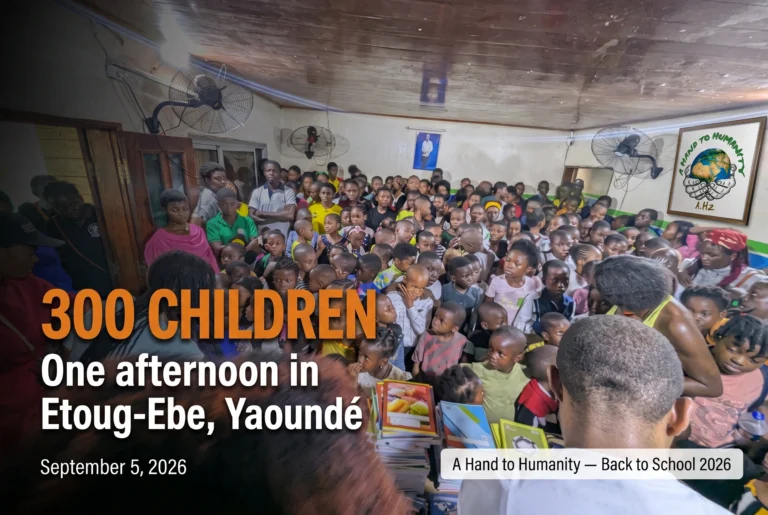
When your team comes with us to a medical campaign in Etoug-Ebe, helps run a school kit distribution, or sits down with the children we serve, something shifts inside the company. The payroll relationship turns into a mission relationship. Retention managers spend fortunes trying to engineer that shift. A structured partnership produces it almost as a side effect.
Win 4 — You get noticed in the rooms where decisions are made.
Inside GECAM circles, members running structured social programmes are getting attention. The signal is read, by other Cameroonian business leaders, as the mark of a serious operator — one who plays the long game.
That signal surfaces where it counts: in board nominations, in industry roundtables, in bilateral chamber events with foreign delegations. These are the rooms where contracts are quietly assigned, where joint ventures begin over coffee, and where reputations are sealed long before press releases go out.
You want to be in those rooms. A documented NGO partnership Cameroon business leaders can name is one of the cheapest, most defensible tickets in.
Win 5 — You inherit a pre-qualified network at zero acquisition cost.
AH2 has built, since 2020, a network of more than 1 000 supporters. They include diaspora professionals working in France, Belgium, Canada and the US; foundation officers; international donors; and institutional contacts inside the Cameroonian Ministry of Health.
These are people who already trust us. When we run a co-branded campaign as part of an NGO partnership Cameroon business engagement, your company surfaces to them through a credible intermediary — which is the most effective form of B2B introduction ever invented, and one of the hardest to buy outright.
You are renting decades of relationship capital we have built one campaign, one report, one handshake at a time. The acquisition cost on your side: zero.
4. The Cost of Doing Nothing in 2026
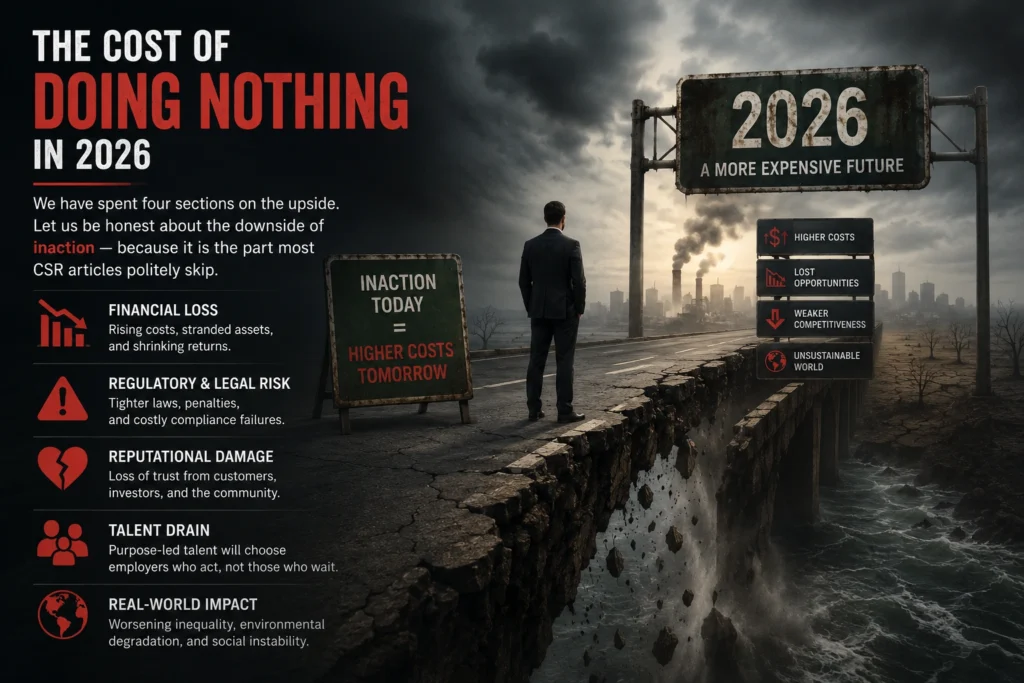
We have spent four sections on the upside. Let us be honest about the downside of inaction — because it is the part most CSR articles politely skip.
A Cameroonian SME that does not structure an NGO partnership Cameroon business framework in 2026 is paying three hidden costs.
It is paying tax that could have legally been redirected. At 0,5% of turnover, the foregone deduction on a 500M FCFA business is 2,5 million FCFA per year — money that is now sitting in the Treasury rather than producing fiscal savings and social impact in your name.
It is losing reputational ground to better-organised competitors. The companies signing structured partnerships this quarter will be the ones named in next year’s GECAM discussions, in newspaper roundups, and in foundation procurement shortlists. The companies waiting will be conspicuously absent — and that absence is increasingly read as a signal.
It is accelerating the talent drain. The employees you cannot retain on salary alone are choosing employers whose work they find meaningful. Every quarter you delay structuring a partnership is a quarter your competitors widen the gap on a metric most CFOs are not yet measuring but soon will.
None of these costs show up on a P&L. All of them compound.
5. How to Start, in Four Steps
Here is the on-ramp AH2 uses with every new partner. It is deliberately simple, because the value of the partnership lies in the work — not in the paperwork.
| Step | What happens | Time |
|---|---|---|
| 1. Discovery call | A 30-minute conversation. We listen to your priorities (tax, brand, retention, market access) and propose a programme axis — drug prevention, orphan care, medical campaigns. | 30 min |
| 2. Convention signing | We co-draft a tailored agreement. Your legal team reviews. We sign. | 5–10 days |
| 3. Launch operation | A co-branded event in Yaoundé (or virtual, for diaspora-owned firms). Your team meets ours. The work begins. Photographs are taken. | 1 day |
| 4. Quarterly impact report | Every 90 days, a written report you can hand to your board, your CFO, your auditor, or your customers. | Quarterly |
The first call carries no fee, no commitment, and no preparation on your side. We just want to understand your business and see whether the fit is real. If it is not, we will say so. We have turned down partnerships in the past when the priorities did not align — because a forced partnership serves neither side.
Disclaimer: The tax framework summarised in this article reflects publicly available sources. It does not constitute personalised tax advice. Verify the specifics of your situation with your tax adviser, or talk to AH2’s partnership team before structuring your engagement.
A Word From the Founder
“We did not start AH2 in 2020 to ask Cameroonian companies for handouts. We started it so that the same companies that build our economy could also build its social fabric — and be proud to say so publicly. Every NGO partnership Cameroon business leaders sign with AH2 is structured to be defensible to your CFO, visible to your customers, and meaningful to the children, families, and patients we serve. We are not asking for charity. We are offering a structured way to win in 2026 — together.”
— Rev. Peter Nillong
Frequently Asked Questions — NGO Partnership Cameroon Business in 2026
How much does an NGO partnership Cameroon business owners sign with AH2 cost?
There is no fixed entry ticket. AH2’s corporate partnerships range from 500 000 FCFA per year for a programme sponsorship to 25M+ FCFA for a multi-year strategic engagement with full co-branded campaigns. The structure is shaped around your priorities, not picked from a list.
Is the partnership really tax-deductible?
Yes. AH2 has been a registered NGO under the Cameroon Ministry of Territorial Administration since 2020. Donations made through a documented partnership are deductible up to 0,5% of annual corporate turnover under Article 7 of the General Tax Code, provided the four documents listed in section 2 are in place.
What is the difference between a donation and an NGO partnership Cameroon business companies sign?
A donation is a one-time transactional gift. An NGO partnership Cameroon business teams sign is a multi-quarter written engagement with shared branding, scheduled impact reporting, and joint communication. Donations get a receipt. Partnerships get a strategy, a tax framework, and a measurable retention impact.
Can a Cameroonian SME with less than 100M FCFA turnover partner with AH2?
Yes. We have programme-sponsorship tiers designed for smaller SMEs, starting at 500 000 FCFA per year. The mechanics — tax deductibility, brand mentions, employee engagement — scale down cleanly, and the partnership stays just as meaningful.
How fast can we sign and launch an NGO partnership Cameroon business engagement?
From first call to signed convention: 10 to 15 working days in our standard process. Launch event within the following 30 days. Your first quarterly impact report 90 days after launch.
Sources & References
- PwC Cameroon — Corporate Deductions Summary: taxsummaries.pwc.com/cameroon/corporate/deductions
- GECAM (formerly GICAM/ECAM) — Member Engagement Framework: gicam.cm
- UN Global Compact — Cameroon Local Network on Corporate Sustainability: unglobalcompact.org
- A Hand to Humanity NGO — About AH2 · Our Mission · Donation Transparency Report · Choosing the Best NGO in Africa
Ready to Sign the Smartest CSR Move of 2026?
Our next partnership cohort closes on 15 July 2026. If your company wants to be named in our next impact report — and earn the tax, brand, and retention wins we have walked through above — let us talk.
→ Schedule your 30-minute discovery call (no fee, no commitment, no preparation)
→ Start a monthly partnership donation today (from 25 000 FCFA / month)
📧 partnership@ahandtohumanity-ngo.org · 📞 +237 694 682 198 · 💬 WhatsApp +237 650 000 498
About the Author
Rev. Peter Nillong is the founder and Executive Director of A Hand to Humanity NGO. An ordained minister with over 10 years of humanitarian and social work across Cameroon, he leads AH2’s strategic partnerships with corporates, foundations, and international donors. AH2 is accredited by ISSUP (2022) and CADCA (2023), and is an institutional partner of the Cameroon Ministry of Health. Connect on LinkedIn.