Two missions, one mission:
dignity restored, measurably.
We exist because compassion without rigor is sentimentality, and rigor without compassion is bureaucracy. A Hand to Humanity refuses both — and operates at the intersection of clinical evidence, community presence, and human dignity.
What we do, today.
Restore dignity to vulnerable populations across Cameroon through holistic, evidence-based programs that meet people where they are — medically, socially, and spiritually.
- Support orphans and vulnerable children through health, education, and hygiene programs.
- Help individuals affected by drug and substance abuse from prevention to reintegration.
- Improve access to healthcare and mental health services in underserved communities.
- Strengthen communities through awareness, education, and capacity-building initiatives.
Where we are going.
A Cameroon — and one day a continent — where every individual has the conditions to live a healthy, dignified, and meaningful life, regardless of background or circumstance.
- Every child grows up in a safe, supportive, and nurturing environment.
- Every person affected by addiction has access to dignified recovery pathways.
- Every vulnerable family can access essential health and education services.
- Every community has the resources to support itself and its most fragile members.
Four pillars that hold every program together.
These are not slogans. They are operational disciplines, applied daily and measured publicly.
Community Engagement
We do not arrive with solutions. We arrive with questions. Every program starts with weeks of listening to local leaders, families, and beneficiaries — because care designed without community input is care that does not last.
Education & Awareness
Prevention is the highest leverage point in any humanitarian work. Our awareness programs on drug abuse, mental health, GBV, and HIV reach thousands annually through schools, community centers, and faith-based partners.
Partnerships & Collaboration
We multiply impact by aligning with institutions: ISSUP, CADCA, Cameroon Ministry of Health, Hope Cell Foundation, and Local Youth Corner. Independent NGOs that resist partnership often resist accountability too.
Monitoring & Accountability
We measure every program against three questions: did it reach the right people, did it produce real outcomes, and could donors verify it? Every annual report publishes these answers — including the failures.
Six programs. One pathway from need to dignity.
Each program is designed to reinforce the others. A child supported in an orphanage today often becomes a community leader who supports prevention programs tomorrow.
Drug Abuse Prevention & Recovery
Prevention, awareness, medical detox, counseling, and social reintegration — a full pathway for individuals and families affected by substance use.
Support RecoveryOrphan & Child Support
130+ orphanages reached since 2020. Healthcare, school supplies, hygiene kits, and emotional support — built around regular follow-up, not one-time deliveries.
Support OrphansHealth & Medical Assistance
Mobile medical consultations, vaccination campaigns, maternal health, and essential medicines — coordinated with the Cameroon Ministry of Health.
Support HealthcarePsychological & Spiritual Support
Mental and emotional wellbeing programs. Individual counseling, group sessions, and faith-anchored support — because healing is rarely only physical.
Learn MoreCommunity Development & Resilience
Education, leadership programs, and capacity-building initiatives that strengthen communities to sustain themselves long after our visit ends.
Learn MoreWASH (Water, Sanitation, Hygiene)
Clean water access, safe sanitation, and hand-washing education — proven interventions that reduce mortality from diarrhea and neglected tropical diseases.
Learn MoreThe problem is real. The pathway out is possible.
In Cameroon today, more than 1 in 4 youth has been exposed to tramadol or related substances. Orphanages outside the capital often go months without organized medical visits. Vulnerable families with chronic illness face health costs that consume entire household budgets.
These are not abstract statistics. They are the lived reality of the children, families, and individuals we meet every month in the field. And they are exactly the conditions that compassion plus rigor were built to change.
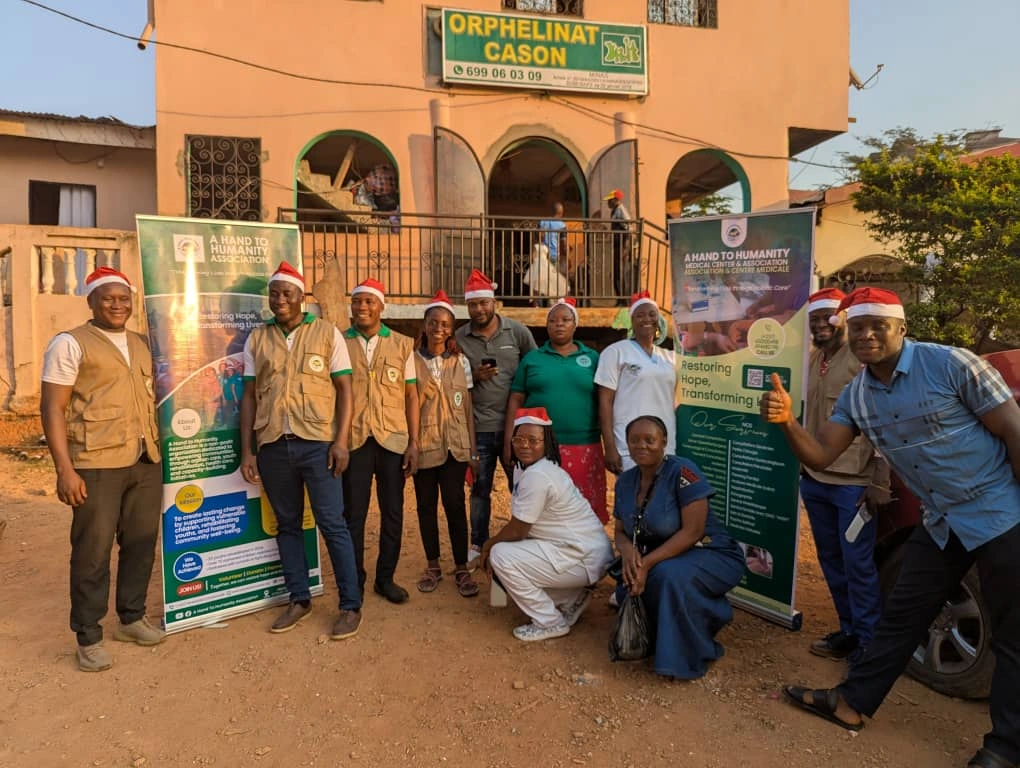
We did not build A Hand to Humanity to manage suffering. We built it to end specific kinds of suffering, one program, one beneficiary, one verified outcome at a time. That is the mission. That is the only mission.
Aligned with six UN Sustainable Development Goals.
Our work contributes directly to global development priorities — not as a marketing claim, but as an operating discipline. Every program maps to specific, measurable SDG targets.
Good Health & Well-being
Medical outreach, mental health, recovery programs.
Quality Education
School supplies and learning support for orphans.
Gender Equality
GBV awareness, survivor support, advocacy.
Clean Water & Sanitation
WASH programs in vulnerable communities.
Reduced Inequalities
Care for the most underserved populations.
Partnerships for the Goals
ISSUP, CADCA, Ministry of Health collaborations.
The questions a thoughtful supporter asks.
-
What is the mission of A Hand to Humanity?
Our mission is to restore dignity to vulnerable populations across Cameroon through holistic, evidence-based programs. We operate along two axes — drug prevention and recovery, and orphanage and child welfare — and we measure every program against publicly disclosed outcomes. -
Who does A Hand to Humanity support?
Three primary populations: children and orphans in care institutions across Cameroon (130+ orphanages reached since 2020), individuals affected by drug and substance use disorders, and underserved communities lacking access to healthcare, education, or social services. We do not turn away beneficiaries based on faith, ethnicity, or background. -
How does A Hand to Humanity address community needs?
Through four operational pillars: community engagement (we listen before we act), education and awareness (prevention reaches more people than treatment ever can), partnerships (with ISSUP, CADCA, the Ministry of Health, and local organizations), and monitoring and accountability (every program is measured against verifiable outcomes). -
How can I support the mission?
Three concrete pathways: donate (one-time or monthly, designated to a specific cause via our donate page); partner (institutional or corporate partnership — contact our team directly); or volunteer (field volunteers, professional skill volunteers, and remote support are all welcome). -
Where does my money actually go?
84% of every donation reaches programme delivery (healthcare, orphanages, recovery, education). 11% covers field operations (transport, logistics, field teams). 5% covers administration. All numbers are tracked, audited, and published in the annual report. -
Is A Hand to Humanity religiously affiliated?
A Hand to Humanity was founded by Rev. Peter Nillong and draws on a tradition of compassion grounded in faith. However, we serve all beneficiaries equally and without religious condition. Our programs are evidence-based, our medical care follows clinical standards, and our recovery work draws on the same protocols used by secular ISSUP and CADCA member organizations globally.
Lasting change happens when
people stop waiting for someone else.
Compassion, paired with rigor, applied consistently — that is the formula. What it requires from each of us is the simple decision to participate. Three pathways. Choose one. Start today.