Cannabis Addiction Help in Cameroon: Real Facts & Proven Support (2026)
Cannabis addiction help in Cameroon is harder to find than it should be — not because services don’t exist, but because most families never believe it’s needed. “It’s just weed.” “He’ll grow out of it.” “That’s not a real addiction.” These words are spoken every day in homes across Yaoundé, Douala, and Bafoussam, while a young person quietly loses their grip on their own future.
This article is for every family that has ever said those words — and later wished they hadn’t.
Why Cannabis Addiction in Cameroon Is More Serious Than You Think
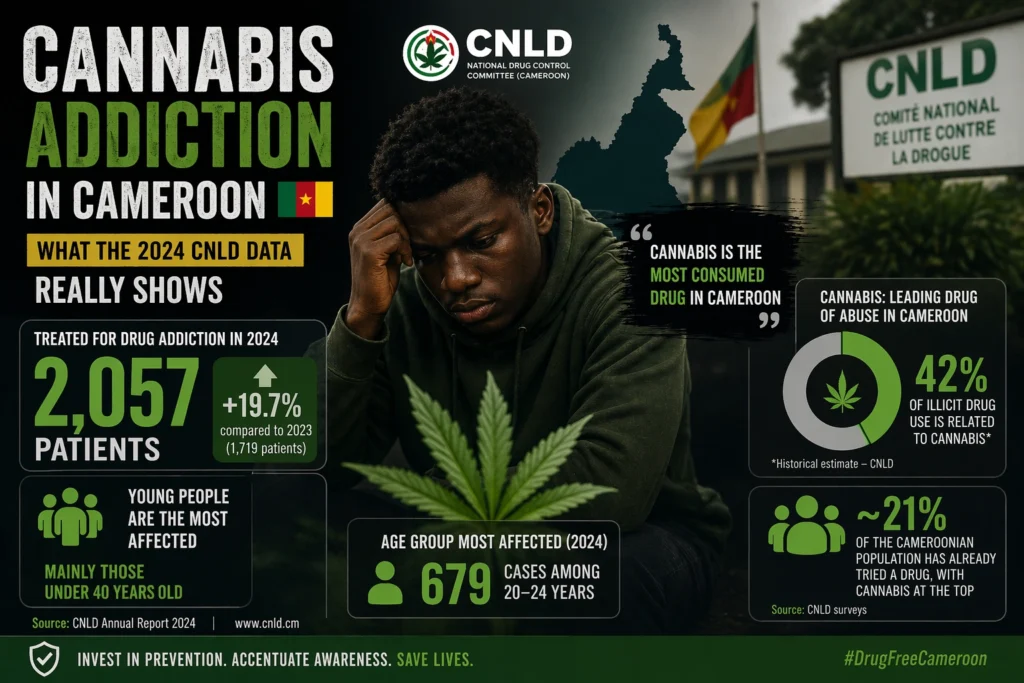
Cannabis is not a minor footnote in Cameroon’s drug crisis. According to the Centre National de Lutte contre la Drogue (CNLD), cannabis accounts for 58.54% of all illegal drug demand in Cameroon — making it by far the most consumed illicit substance in the country. More young Cameroonians are dependent on cannabis than on tramadol, cocaine, and heroin combined.
Yet it remains the most dismissed.
Part of the reason is cultural. Cannabis has been present in Central Africa for generations. It carries informal names, social rituals, and a reputation for being “soft.” Another reason is that cannabis dependency does not always look dramatic. There is no needle. There is no sudden collapse. The changes are slow — a teenager who stops caring about school, a young man who becomes irritable and withdrawn, a student who can no longer concentrate for more than a few minutes.
This is what cannabis addiction in Cameroon actually looks like: quiet, gradual, and easy to explain away until it’s very hard to reverse.
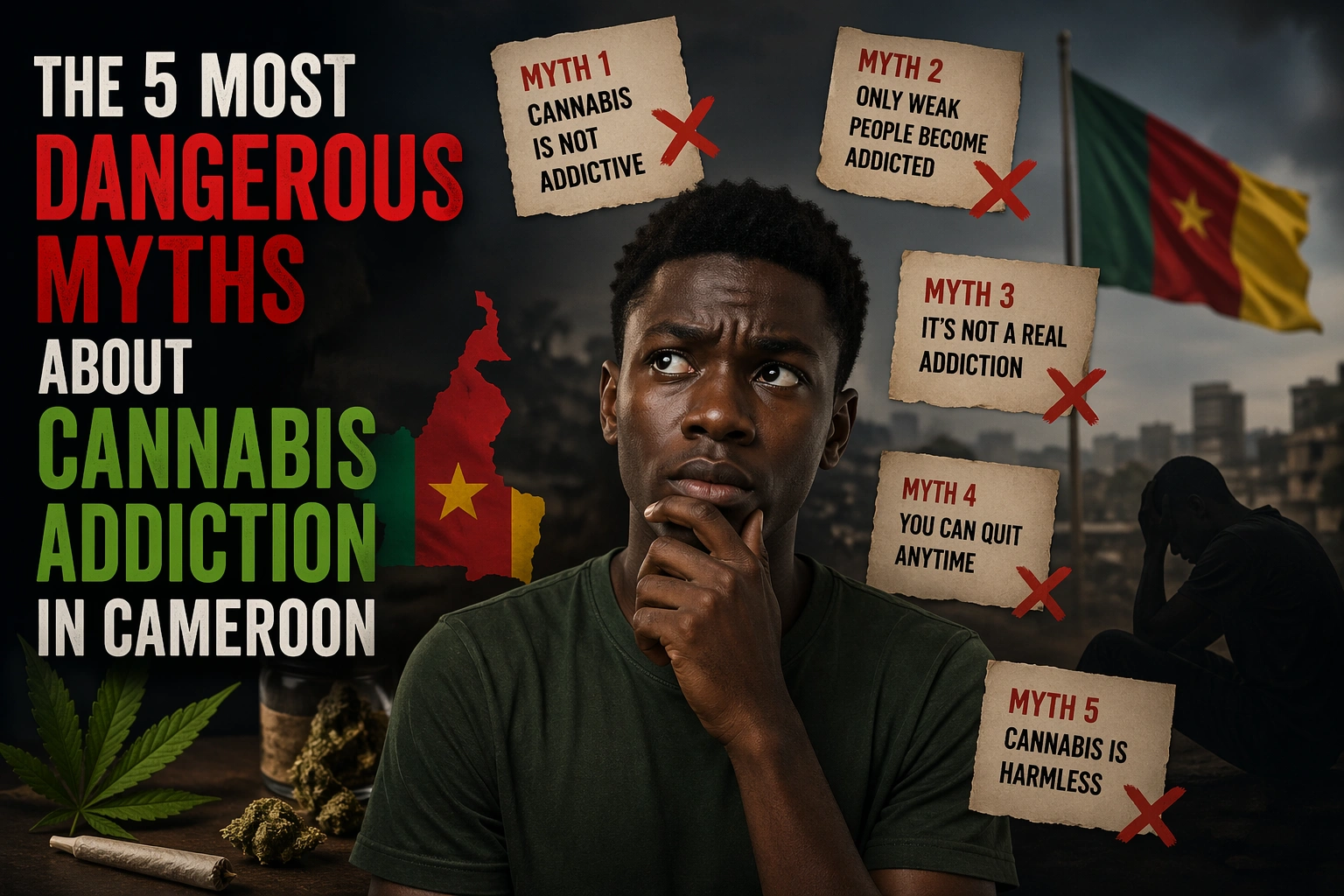
The 5 Most Dangerous Myths About Cannabis Addiction in Cameroon
Myths are not harmless. In this context, they delay help — sometimes by years. Here are the five most common ones families believe, and what the evidence actually says.
Myth 1: “Cannabis is not addictive.” According to the World Health Organisation, approximately 9% of people who use cannabis will develop a dependency — rising to 17% for those who begin in adolescence. For daily users, the figure reaches 25–50%. The substance itself triggers real neurological changes over time, particularly in the developing brains of young people under 25.
Myth 2: “You can stop whenever you want.” Cannabis dependency includes real withdrawal symptoms: anxiety, sleep disruption, loss of appetite, mood swings, and intense cravings. Many users genuinely struggle to stop without structured support. “Just stopping” is no more realistic for a dependent user than it would be with alcohol.
Myth 3: “It only affects lazy people or bad families.” Cannabis dependency does not sort by family background, religion, or academic performance. It affects students, professionals, churchgoers, and athletes. Shame and social stigma are among the biggest reasons families delay seeking cannabis addiction help in Cameroon — and among the biggest obstacles to recovery.
Myth 4: “Smoking cannabis is less harmful than drinking alcohol.” Regular cannabis use has been linked by PubMed research to increased rates of psychosis, impaired memory formation, reduced educational attainment, and — when smoked — respiratory damage. In adolescents, early and regular use is associated with a significantly higher risk of developing anxiety disorders and depression.
Myth 5: “He’ll grow out of it.” Some do. Many do not. And for those who don’t, each year of unaddressed dependency costs them academic progress, professional opportunities, and mental health. The most effective interventions happen early — not after the problem has compounded for five or ten years.
How to Recognise Cannabis Dependency in Someone You Love
Knowing when to seek cannabis addiction help in Cameroon begins with honest observation. Dependency is not about how often someone smokes — it is about what happens when they don’t. Ask yourself these questions:
- Does he become irritable, anxious, or aggressive when he hasn’t smoked?
- Has he lost interest in things that used to matter to him — sports, church, school, ambitions?
- Does he minimise or hide how much he uses?
- Has his performance at school or work declined noticeably over the past year?
- Does he need cannabis to feel “normal” or to sleep?
Two or more of these patterns, persisting over several months, suggests a dependency that will not resolve on its own. This is the moment to act — calmly, without accusation, but firmly.
Where to Find Real Cannabis Addiction Help in Cameroon
Cannabis addiction help in Cameroon exists — and accessing it does not require money, connections, or a formal diagnosis. The challenge for most families is simply knowing where to look. Many delay seeking cannabis addiction help in Cameroon because they fear judgment or don’t know who to trust. That hesitation is understandable, but it costs time that a young person cannot afford to lose.
A Hand to Humanity (AH2) is a Yaoundé-based humanitarian NGO working directly in the area of drug prevention and addiction recovery in Central Africa. Founded by Rev. Peter Nillong and officially partnered with the Ministry of Health Cameroon, CADCA, and ISSUP, AH2 offers a structured pathway for families navigating cannabis dependency:
- Private consultation — speak with a trained recovery specialist who understands both the clinical and cultural dimensions of addiction in Cameroon
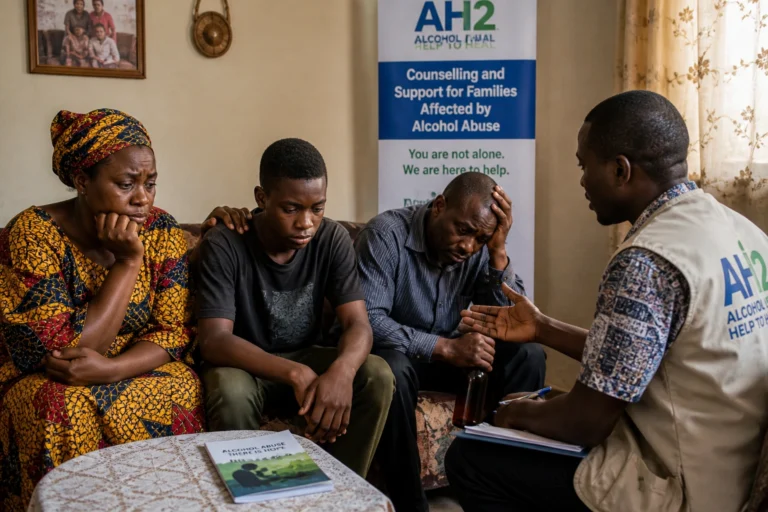
- Family guidance — many families don’t know how to approach a loved one without triggering denial or conflict; AH2 helps families communicate effectively
- Recovery support — structured follow-up for young people who are ready to begin the process of change
AH2 does not judge. There is no social stigma, no public exposure, no condemnation. The team understands what Cameroonian families face — because they live and work in the same communities.
To speak with someone today, visit our Contact page or call +237 694-682-198 directly. You can also learn more about our drug recovery programme and what support looks like in practice.
If your family has not yet been affected, consider making a donation — your support funds free community outreach and makes early intervention possible for families who cannot afford private care.
The Decision That Changes Everything
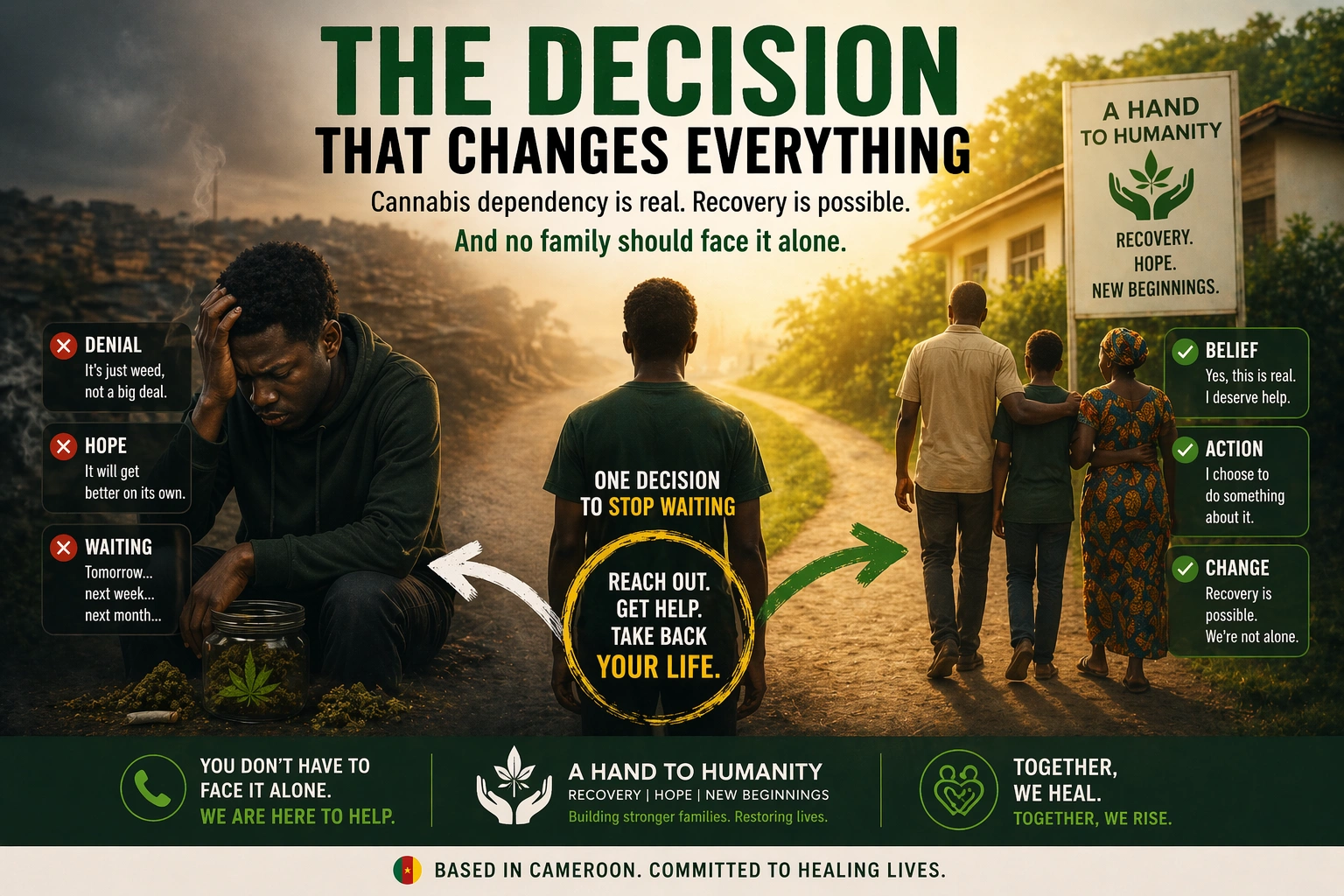
The hardest part of seeking cannabis addiction help in Cameroon is not finding the phone number. It is believing that the problem is real enough to act on.
Every family that has come through the doors of A Hand to Humanity started exactly where you are now — uncertain, perhaps hoping things would improve on their own. What separated the ones who found their way forward was one decision: to stop waiting.
Cannabis dependency is real. Recovery is possible. And no family should face it alone.
Reach out today — contact A Hand to Humanity and take the first step.
Is cannabis really addictive?
Yes. The World Health Organisation confirms that around 9% of cannabis users develop a dependency, rising to 17% among those who start as teenagers. Regular users face real withdrawal symptoms when they stop — including anxiety, insomnia, irritability, and intense cravings. It is a recognised medical condition, not a question of willpower.
What are the signs that my child is dependent on cannabis?
Key signs include: increasing irritability or aggression when not smoking, loss of motivation and interest in school or activities they previously enjoyed, secrecy around their habits, declining academic or work performance, and needing cannabis to sleep or feel calm. If two or more of these persist over several months, it is time to seek help.
Is cannabis the most used drug in Cameroon?
Yes. According to the CNLD (Centre National de Lutte contre la Drogue), cannabis accounts for 58.54% of all illegal drug demand in Cameroon — more than tramadol, heroin, and cocaine combined. It is by far the most widely consumed illicit substance in the country.
Can someone recover from cannabis addiction without professional help?
Some people manage to stop alone, but dependency — especially long-term daily use — carries withdrawal symptoms that make self-stopping very difficult. Structured support significantly improves the chances of lasting recovery and helps address the underlying reasons for use.
How does A Hand to Humanity help with cannabis addiction in Cameroon?
A Hand to Humanity offers private consultations, family guidance, and structured recovery support for individuals and families affected by cannabis dependency in Cameroon. The service is confidential, non-judgmental, and conducted by trained specialists. You can reach the team via the contact page or by calling +237 694-682-198.